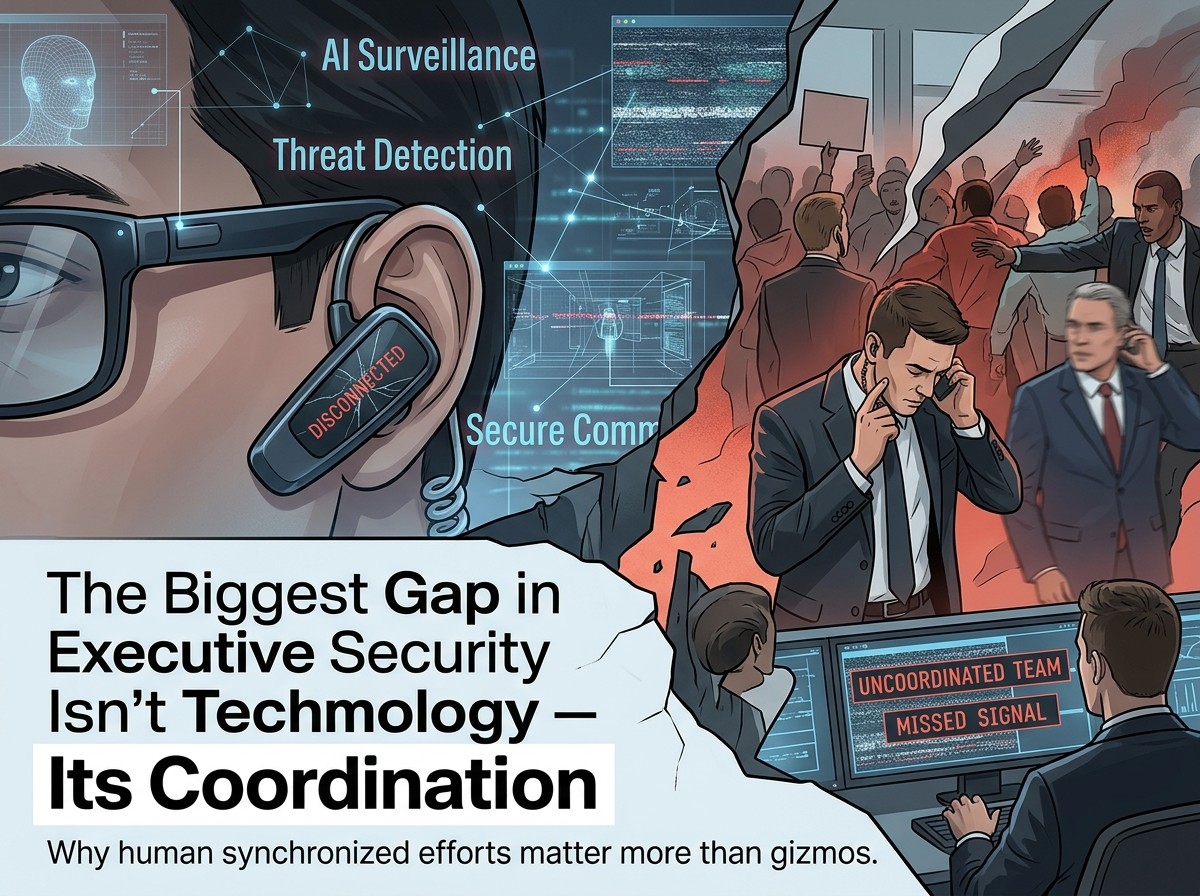
Picture a scenario that plays out more often than most security professionals would like to admit: A threat against a Fortune 500 CEO begins on a fringe internet forum. A physical security team, focused on building access logs and travel schedules, never sees it. An IT security team, monitoring network intrusions and phishing attempts, has no protocol for flagging human threats. And the executive protection detail, skilled in advance work and motorcades, has no visibility into either world.
Unfortunately, many times, by the time the threat materializes, the three teams are reacting separately to a crisis that a unified intelligence picture might have prevented entirely.
Fortunately, this is one of the most urgent and most solvable structural failures in enterprise security today.
Three Teams. One Threat. Zero Coordination.
In many organizations, physical security, cybersecurity, and executive protection operate as distinct functions. They have separate reporting lines, budgets, vocabularies, and in many cases, separate floors. Physical security reports to facilities or legal. IT security reports to the CIO or CISO. Executive protection may report to the CEO’s office, HR, or legal.
That logic made sense when the threat landscape was more divided: physical threats were physical, cyber threats were digital, and the two rarely intersected. That world no longer exists.
Today, threat actors operate across both domains simultaneously and with fluency. A disgruntled former employee may begin by posting grievances on LinkedIn, escalate to searching public records for a home address, and ultimately show up at an executive’s residence, leaving a trail of digital breadcrumbs that three separate teams each saw a piece of but none assembled into a complete picture. A sophisticated adversary targeting a CEO may use a phishing email not to steal data, but to map the executive’s daily schedule, identify family members, and pinpoint vulnerabilities in physical routines. We have all seen this.
When cyber and physical threats converge, siloed security structures don’t just underperform; they create dangerous blind spots.
The Intelligence Gap in Converged Cyber-Physical Security
At the heart of the convergence problem is an intelligence gap: the failure to connect signals across domains into a unified executive threat picture.
Open-source intelligence (OSINT), the collection and analysis of publicly available information, is now a core tradecraft of threat actors targeting executives:
- Data broker sites aggregate home addresses, vehicle registrations, relatives' names, and property records.
- Social media platforms publish real-time location data, travel patterns, and family milestones.
- Professional networks like LinkedIn reveal organizational structures, assistant names, and travel schedules.
Taken individually, none of these information sources is alarming. Assembled together, they constitute a detailed operational profile.
The irony is that this same OSINT capability, when deployed by a skilled protective intelligence team, can identify threats before they materialize:
- Social media monitoring can surface threatening language weeks before a confrontation.
- Dark web and forum scanning can detect planning activity.
- Digital footprint analysis can reveal which executives are most exposed and prioritize hardening efforts accordingly.
This kind of cross-domain intelligence work requires a function that doesn’t fit neatly into any of the three traditional silos. It sits between them, which means something can fall through the cracks.
Building a program that connects all parties and platforms is imperative in today’s OSINT environment of exposure.
How to Close the Executive Security Coordination Gap
Shared Intelligence Protocols
The most fundamental change organizations can make is establishing formal mechanisms for intelligence sharing across security functions.
This means regular joint briefings, shared threat assessment platforms, and clear escalation paths when a signal in one domain has implications for another. An IT security team that detects spear-phishing targeting an executive should have a direct and rapid line to the EP detail. A physical security team that observes surveillance of an executive’s residence should have access to digital threat context.
Unified Incident Response
When a converged threat event occurs, organizations need incident response plans that simultaneously bring all three functions to the same table immediately.
Today, many times, a cyber incident triggers an IT response, which eventually alerts physical security, which eventually notifies the EP team. Each handoff introduces delay and information loss. Unified response planning eliminates the handoffs.
Cross-Disciplinary Training
EP professionals do not need to become cybersecurity experts. But they do need enough fluency in digital threat indicators to recognize when information they encounter, such as a threatening social media post, an unusual pattern in an executive’s digital footprint, or a spike in online attention, warrants escalation to a cyber-informed colleague. Similarly, IT security professionals benefit from understanding the physical implications of the digital threats they monitor.
Cross-training builds the shared vocabulary that makes communication across silos possible.
Digital Footprint Reduction as a Protective Measure
The best time to address digital exposure is before it becomes a threat vector. Proactive removal of personal information from data broker sites, hardening of home network and IoT environments, and guidance on social media practices can meaningfully reduce the surface area available to threat actors. This kind of proactive digital hygiene is increasingly a standard component of executive protection programs, for organizations that have recognized the cyber-physical connection.
The Role of AI in Executive Security
AI tools surface signals; they do not replace the human judgment required to assess context, evaluate credibility, and make consequential decisions about protective response.
The value of AI in converged security lies in its ability to dramatically improve the speed and coverage of signal collection, ensuring that the human analysts and EP professionals who make decisions have a more complete and timelier picture to work from.
Related topics: executive protection program, cyber-physical convergence, OSINT for executive security, protective intelligence, digital footprint reduction, enterprise security coordination, executive digital protection, unified threat intelligence, converged security, EP and cybersecurity integration